Whether you run a trade business, an accounting firm, or a small restaurant: Swiss employers are legally required to record the working hours of their employees. Many SMEs underestimate this obligation — or don't know exactly what needs to be tracked.
The Legal Basis: Art. 46 Labour Act
The obligation to record working hours stems from the Labour Act (ArG), specifically Art. 46, and the Labour Act Ordinance 1 (ArGV 1). Employers must keep records of:
- Daily working hours and rest periods for each employee
- The number of overtime hours worked
- Absences (illness, holidays, military service, etc.)
These records must be kept for at least 5 years and made available to enforcement authorities on request.
Who Is Affected?
The Labour Act applies to virtually all businesses subject to ArG — covering the vast majority of Swiss SMEs. Only certain categories are exempt or subject to simplified rules:
- Senior employees with genuine decision-making authority (simplified recording possible)
- Field staff with autonomous time management (also simplified)
- Businesses covered by a collective labour agreement (CLA) with different rules
What Exactly Must Be Recorded?
For businesses with full time-recording obligations:
- Start and end of daily working hours (including breaks over 30 minutes)
- Weekly working hours (target vs. actual)
- Overtime — tracked separately
- Night and Sunday work — where applicable
Records don't have to be digital. Paper timesheets or Excel lists technically meet the minimum legal requirements, but they're time-consuming and error-prone in practice.
Common Mistakes by SMEs
- No records or incomplete records — especially in micro-businesses
- Overtime not tracked separately
- Records deleted after 2 years instead of the required 5
- No employee sign-off — recommended and valuable in case of disputes
The Simple Solution: An App
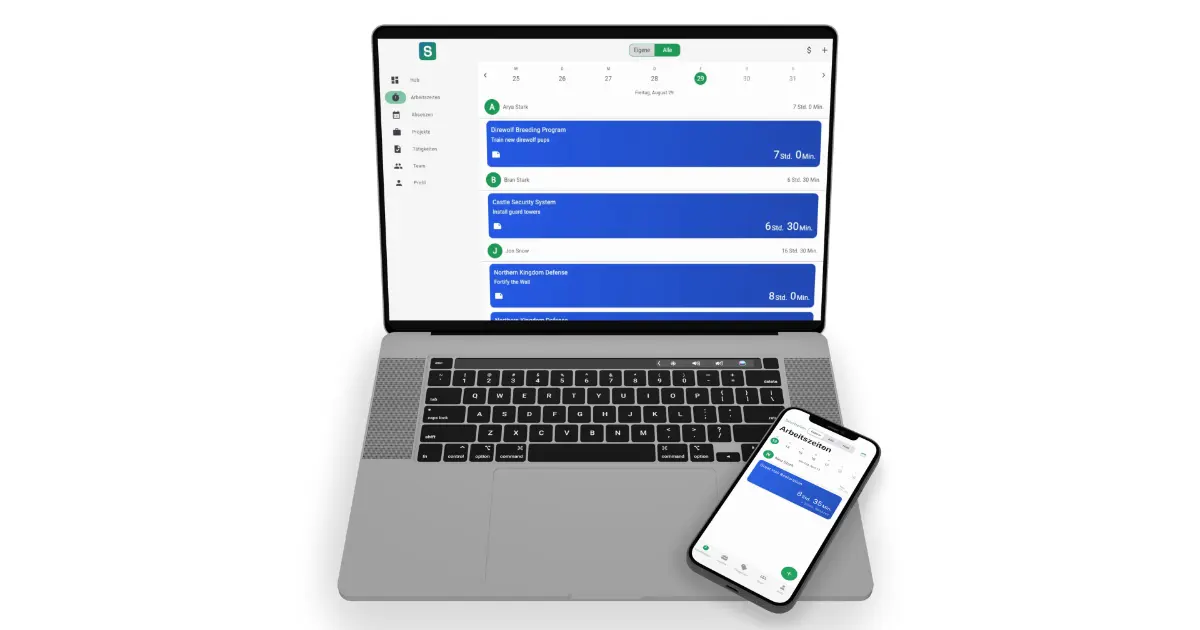
Instead of paper forms or messy spreadsheets, SMEs can use a simple time tracking app. With Samay, employees log their hours directly on their phone — even offline in the field. Managers get a real-time overview, overtime is calculated automatically, and PDF reports for filing can be generated in one tap.
The result: the legal obligation is fulfilled without anyone manually updating spreadsheets back at the office.
Summary
Time tracking in Switzerland isn't optional — it's a legal requirement for almost all SMEs. Understanding the rules and setting up a simple system early saves a lot of trouble if an inspection happens. A good time tracking app typically pays for itself within weeks through saved admin time.
